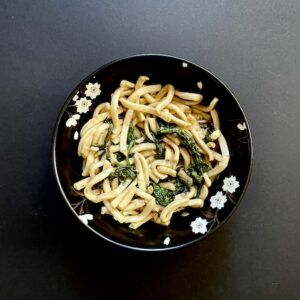

Stir-fried arugula with Asian noodles–they’re Udon noodles, if you must know–came about like many of my recipes: while I was distracted.

Chinese preserved egg.
By “distracted” I mean I was testing another recipe: adding various seasonings, tasting, and making lots of illegible notes.

Late afternoon rapidly became early evening. The recipe I’d been tinkering with would serve as a main dish, but I needed a side.
Into the Kitchen.
You know those plastic boxes of salad greens? Pre-washed, organic, open and go? They’re vaguely illicit for numerous reasons. There’s the packaging, which is recyclable, but it’s still plastic, and we’re a long way from The Graduate.

I do not make a habit of buying boxed greens, but I’m not gonna lie: the first time I made this recipe, the baby arugula came out of one of those boxes. And it was indeed convenient.
Moving right along. Let us discuss today’s stir-frying medium, sesame oil. There are two kinds of sesame oil out there: toasted and not. Authentic Asian recipes rarely call for cooking with either kind. Toasted sesame oil is used as a finishing oil, meant for drizzling over cooked dishes or used in dipping sauces. It has a smoke point of about 350F/180C–low when you consider stir-frying, a technique calling for searing heat. As this recipe doesn’t use toasted sesame oil, I didn’t have a photo to share. Then I found a group picture, so to speak. Note the Kadoya Roasted Sesame Oil, front right.

Today’s recipe calls for stir-frying with untoasted sesame oil, which has a smoke point of 410F/210C. It is inexpensive and easily found in supermarkets. Did I remember to photograph the empty bottle before tossing it into the recycling? Of course not.

I used udon noodles because I keep them in the house. The brand I use is sold in packages of three; each pack contains 10 ounces. The noodles are par-cooked and only need to be heated. If you want to use another noodle, thicker types will work best with this recipe.

This advice applies to the greens as well. If baby arugula is not on your shopping list, fine. Try using a green with some bite, like mustard or cress, but if this is impossible, mixed salad greens, kale, beet greens, dandelion greens, or greens sold as “salad mix” are all fine choices. Below, salad mix from my local farmer’s market.

The second time I made this dish, I added Aleppo pepper and powdered garlic just before serving. My very careful notation reads “lots.” Should you wish to follow this helpful note, I would say “to taste.”

As I adore spicy food and my husband does not, hot chili oil and XO sauce were placed on the table.

Stir-fried arugula with Asian noodles can be a main or side dish, depending on what else is served. Note that it is vegan in the best possible way: naturally occuring.

Finally, stir-fried arugula with Asian noodles is amenable to additions like firm tofu, pork, chicken, water chestnuts, walnuts, or mushrooms….the list is long, appetizing, and at this challenging time, inexpensive.

Stir-Fried Arugula With Asian Noodles
Prep time: minimal
Serves: amounts given serve 2, but this is easily scaled upward
Do not use toasted sesame oil in this recipe. It is not meant for stir-frying.
Please read notes, below, for recipe variations and ideas.
This recipe is best prepared in a 14-inch wok. If you don’t have a wok, use your biggest sturdy frying pan.
3-4 tablespoons untoasted Asian sesame oil
3-4 tablespoons Shao Xing rice wine, dry sherry, or white wine (non-drinkers use water or unsalted vegetable broth)
2 pounds/1 kilo baby arugula or other peppery greens, washed, dried, and chopped small, if necessary
approx 16 ounces/500 grams Asian noodles, ideally Udon (see notes)
Optional:
1 minced garlic clove
1 scallion, sliced into thin rings
a piece of fresh ginger, minced
salt and pepper, to taste
Aleppo pepper, to taste
Garlic powder, to taste
Prep your greens, if necessary.
Open window and/or turn on oven fan.
Heat your wok until smoking. If using a pan that can tolerate pre-heating, go for it. If not, skip this step.
Carefully pour a generous 3-4 tablespoons sesame oil wok or other wide, deep, heatproof pan. Step back, and pour rice wine down side of pan.
Turn heat down a bit and add garlic, scallion, and ginger, if using. Stir fry for a few moments.
Now add the arugula. Using a wok spatula or comparable implement, stir continuously, marvelling as the huge pile of greens cooks down. Stir-fry for a few minutes.
Add the noodles. If additional liquid is needed, add water, more rice wine, or broth, should some be handy. Stir noodles and greens, adding liquid if needed. The dish should be moist but not soupy.
Depending on the type of noodles you’re using, stir-fried arugula with Asian noodles will take 3-5 minutes to cook. If you are using larger, older greens, cooking time will be longer.
Turn heat down and taste for seasoning. You may want to add salt, pepper, or a splash of soy sauce. As noted in the post, I added Aleppo pepper and garlic powder to one version, so pass that along.
Serve immediately with your favorite condiments. At our house this means chili oil and XO Sauce.
Leftover stir-fry may be refrigerated in a covered container up to three days. Stir-fried arugula with Asian noodles is not the best keeper: after a few days the noodles become gluey. Eat this up quickly.
Notes:
I used a ratio of 2 pounds/1 kilo greens to 16 ounces/500 grams noodles. These amounts are not cast in stone. Adjust them as you please.
As discussed in the post, the recipe uses pre-washed baby arugula, which requires no prep. Use whatever greens you like, bearing in mind peppery greens are ideal. Cooking times may be longer for older, tougher greens.
I use udon noodles sold in ten-ounce packages. I make this dish with two packs, or 20 ounces, but for ease of translation into metric, call for for 16 ounces/500 grams in the recipe. We’re not baking a cake here; precision isn’t essential. As with the greens, use whatever noodles you prefer. Thicker noodles work best in this recipe.
Theme and variation: add chopped cooked chicken, pork, or firm tofu. Korean rice sticks would be good here, and yes, I know it’s double starch. Water chestnuts, walnuts, and mushrooms would also be good.